The Momo Race Evo Aluminum gear knob blends leather and aluminum for a unique style. Check availability.
Search in blog
Blog categories
Archived posts
Search in blog
Blog categories
Latest posts
The Momo Race Evo Aluminum gear knob blends leather and aluminum for a unique style. Check availability.
AUTOSOL Shine Tube 75 ml: enhance your car's finish with impeccable shine.
The Occ Motorsport oil leak stopper helps keep your engine in top condition. Check the product details for more...
Refresh and protect exterior plastics with high adhesion. Ideal for cars.
Transform your rims with Foliatec's White Rim Design Pin. Includes mounting aid.
Popular posts
Archived posts
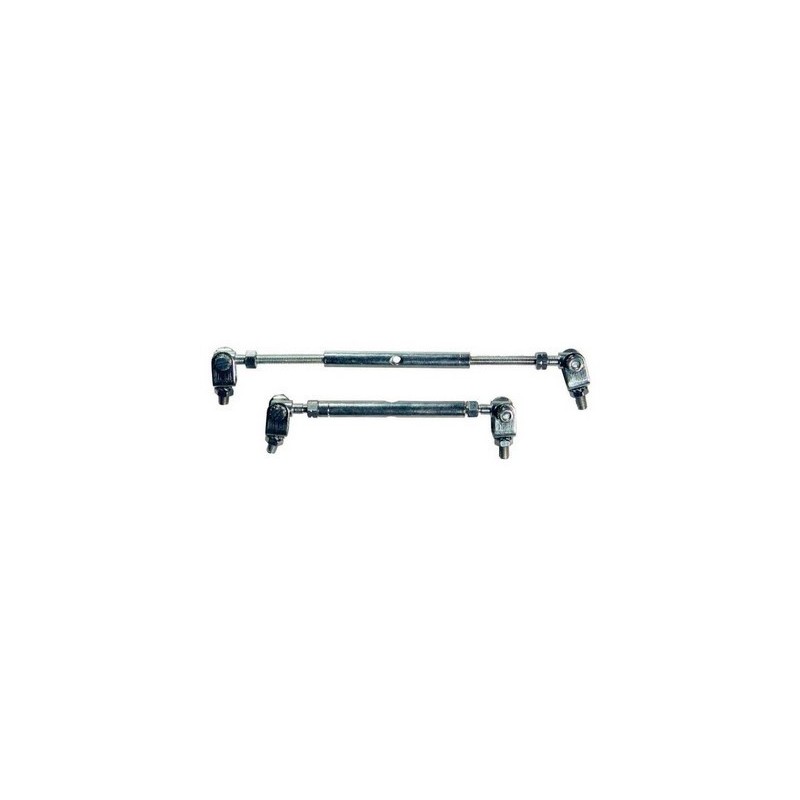
Do you know what a family car doing 300 km of highway every week and a track missile entering a curve at full throttle at 140 have in common? Exactly: both rely on an apparently simple piece called a stabilizer bar to avoid rolling, tilting like a sailboat, and keeping the line under control.
Because yes, we're talking about a metal rod that barely takes up space under your car, but that directly influences how your vehicle behaves on curves, how it feels at the wheel, and how much safety it gives you in limit situations.
Today we're going to dive deep—really—into stabilizer bars: what they are, how they work, why they matter more than you think, and what you should consider before changing or upgrading yours.
This article is not designed to blow smoke at you or to drop a catalog of references without context. What comes next is designed so you can make an informed—and useful—decision about something as relevant as your car's stability.
What is really a stabilizer bar? Because no, it's not just "a metal rod".
How it affects your car's behavior, from a utility vehicle to a sports car.
What types exist and why not all are suitable for everything.
How to install them, what tools you need, and when it's better to see a professional.
Let's go.
The function is simple to explain, but complex to execute: to minimize the lateral roll of the car when taking curves or in response to sudden direction changes. The key? Distributing forces between the wheels of the same axle to prevent the body from tilting too much.
By connecting the left and right suspensions of the same axle through a rigid bar that "twists" when it detects height or load differences between both sides. The more the car tilts, the more the bar works to "straighten it".
The result: more grip, more safety, more precision. And it's not just for those seeking performance. A good stabilizer bar reduces uneven tire wear, improves comfort and allows you to react better in an emergency braking.
Most do. At least on the front axle. But they don't always perform exceptionally. Many stock vehicles opt for soft bars, designed to absorb bumps and provide comfortable driving, but with a clear trade-off: more body roll, less firmness in corners.
And on the rear axle… it depends. In more basic cars there isn't even one. In SUVs or estate cars, there is, but it may fall short.
The good news? You can improve it. The bad news? Not just any bar will do.
Here's where things get serious. If your car has sporting aspirations, or if you do when driving it, the stabilizer bars take center stage
Stiffness: sports bars are thicker, more resistant and more responsive.
Adjustability: many include multiple mounting points to adjust stiffness.
Weight and materials: some are hollow to lighten without losing rigidity, others combine steel and composite materials.
Final objective: gain millimeters in grip, cut seconds per lap and have the car "tied down" at all times.
Do you drive in the city daily and take long trips? Prioritize comfort and reinforced front bar.
Do you like entering roundabouts hard or taking curves like an S on a track? You need a stiffer bar and possibly front + rear.
Do you participate in track days, time attacks, or competition? Go for adjustable bars and premium materials.
Check what it already has installed:
Only front? Adding a rear can balance cornering.
Sport suspension? Pairing it with a stabilizer bar is the logical choice.
Rubber bushings? Consider replacing them with reinforced polyurethane if you want greater efficiency.
Don't risk it with generic parts. At CKC Autosport we work with references for each specific model.
Explore our complete section and filter by brand, model, year and type of use.
Less lean in corners. And you can see it with your own eyes.
Better handling: the car responds faster and turns more flat.
Greater sense of control: there is no delay between what you turn and what happens.
Better weight distribution in fast corners.
More precise driving on all types of roads.
If you overdo the stiffness, the car can become uncomfortable on broken asphalt.
It can also cause loss of traction in one wheel, especially if you don't properly adjust the rest of the suspension.
Poor installation generates noise, tension, or even breakage.
Recommendation? Get professional advice, and if you have doubts, don't install it yourself. Find a trusted workshop.
If you have the knowledge, tools, and patience, you can do it yourself. But it's not like changing a tire. You need:
A jack or jack stands.
A torque wrench.
Knowledge of what torque to apply to the attachment points.
And most importantly: install with the car under load, not in the air.
Small installation error = big problems later.
That's when the magic starts. The synergy between parts is the key.
A stabilizer bar with lowered springs reduces the center of gravity.
If you add sport shock absorbers, you improve rebound and damping.
Adding strut tower braces provides extra rigidity to the setup.
And if you complete it with sport bushings, the driving feel improves dramatically.
It's not senseless tuning. It's a coherent fine-tuning.
Yes, and it can improve behavior a lot. But be careful: it can increase oversteer if not balanced well.
A stiffer bar can make it somewhat firmer. But if you choose well, you shouldn't notice discomfort in the city.
It depends. If you replace an OEM bar with a similar one, normally not. If there was no previous bar or you change the geometry, it's better to consult a homologator.
Yes, they can break (especially if they are old or low quality). The car will be more unstable until you fix it. Don't ignore it.
After all, what you get with a good stabilizer bar is not just firmer driving. It's the feeling of having your car under control when you need it most: in that swerve to avoid something, in that fast curve in the rain, or in that stretch where you want to feel that your car and you are as one.
And in case you were wondering, it's not an upgrade exclusive to sports cars. It's a logical, effective and reliable way to take your car one step further.
Ready to choose yours?
Take a look at the available options atCKC Autosport and let yourself be advised.
You have models for all types of use, cars and budgets, backed by brands that mean business: Sparco, MOMO, OMP, Recaro…
And if you have doubts, you know: better to ask than to improvise. Because in something as serious as your car's stability, every detail matters
Related posts
check_circle
check_circle
Leave a comment